|
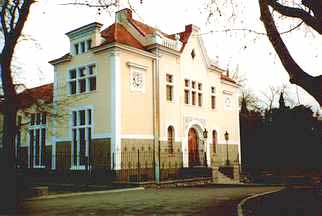
The artistic interior,
newly created, includes a modeling, which consists of thousands
of elements, more than 100 sq.m of colour stained glass
windows, metal fences and others. And as a result of all
job made the building for technical purposes turned into
a magnificent architectural ensemble.
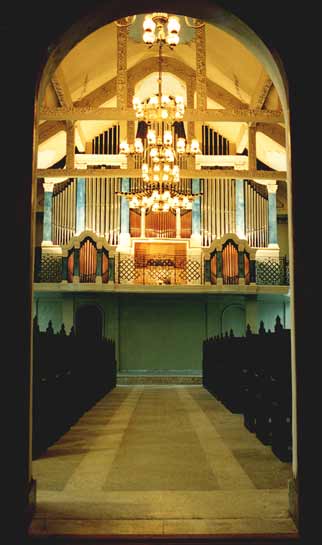
A new big organ in Livadia, put in
action in 1998, is the first home instrument of that class,
made on the territory of the former Soviet Union and the
most huge in Ukraine. The organ has more than 4600 pipes.
The length of the biggest pipe is about 6 meters and of
the smallest is several milimetres. The pipes are divided
into 69 groups (registers) and ruled by the organ's control
system with the help of 4 keyboards (manuals) and 1 foot
keybofrd (pedals) through the complicated system of traction.
There are 220 buttons and levers to rule (manipulate) the
registers. (Please see organ disposition)
Wood of local kinds of trees (cedar,
cypress, pine, cak, beech), some tropical tipes and also
non-ferrous metals (tin, lead, cooper, brass) were widely
used during the building of the instrument, its mechanical
parts. The latest achievements of electronics (computer,
electronical memory) go side by side with the traditional
organ's mechanics in the instrument.
Today the centre of organ music in
Livadia is only one enterprise on the territory of the Union
of Independent States which builds instruments of the kind
and posseses the closed cycle of industry (independent of
foreign suppliers and makes everything itself). Except the
mentioned above the enterprise is occupied with restoration
and reconstruction of organs on the territory of the Union
of Independent States and has the constant cast of musicians
- performers on the instrument.
|
|
|